
FareVet’s 2025 Report
- Fare Vet
- Mar 24
- 4 min read

Insights & Data
What a Full Year of Pet ParentsTaught Us About Vet Costs
We collected hundreds of real requests from pet owners across the US. Here's what the data and the stories behind it actually reveal.
When we built FareVet, we had a theory: pet parents are flying blind when it comes to vet costs. A year of real submissions proved us right and then showed us just how deep the problem goes.
Over the past twelve months, we received thousands of requests from pet owners across the United States and beyond. They came from big cities and small towns, from people with insurance and people without, from panicked pet parents facing emergencies and cautious ones planning ahead. What they shared with us paints a vivid, sometimes heartbreaking picture of what it's really like to navigate veterinary costs in America today.
This is what we learned.
Finding 01
The procedures people worry about most aren't the routine ones
It would be easy to assume that most price-shopping happens around vaccines and annual checkups. The reality is more urgent. The overwhelming majority of FareVet requests came in around procedures that are expensive, unexpected, and non-negotiable, the kind of thing you can't just skip.

That last category, euthanasia, was one of the most sobering to see. Pet parents reaching out in that moment aren't being callous. They're often trying to make an impossible situation slightly less financially crushing, sometimes comparing costs between an in-clinic procedure and an at-home service while grieving a companion they've had for a decade.

The message above isn't unusual. What struck us over and over again is how often people reached out not because they were trying to cheap out on their pet's care but because they'd already received an estimate, were in shock, and needed to know if it was reasonable. Price transparency isn't about avoiding the vet. It's about walking in with your eyes open.
Finding 02
Cost stress is everywhere not just in expensive cities
We expected most requests to cluster in high cost-of-living metros. What we actually saw was a map that covered nearly every corner of the country. From Hartford, CT to Columbus, GA. From Eugene, OR to Grayslake, IL. From Battle Ground, WA to Asheville, NC.

Veterinary cost anxiety isn't a coastal problem or a wealth problem. It's universal. A retired pet owner on a fixed income in Arizona faces the exact same pricing opacity as a working professional in New Jersey. The difference is how much margin they have to absorb a surprise.

Finding 03
Insurance doesn't solve the problem it just changes it
One of our biggest surprises: a significant portion of people who reached out already had pet insurance. Trupanion, Guardian, and others appeared regularly in our submissions. And yet they were still coming to FareVet.
Why? Because insurance covers a portion of a bill but it doesn't tell you whether the bill itself is fair. A $12,000 estimate for a Bulla Osteotomy in Greenville, SC (yes, that's a real submission we received) might be partially covered but is $12,000 even the right number? Is that what clinics in the area actually charge? Pet parents with insurance still need a benchmark.
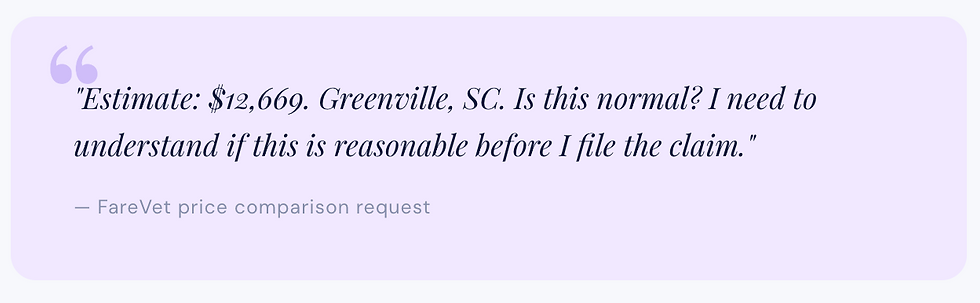
This is the gap that FareVet exists to fill. Insurance is a financial product. Price transparency is an information product. You need both, and right now, most pet parents only have one.
Finding 04
People are willing to travel but only so far
When we ask users how far they'd go for a lower-cost option, the most common answer is 10 to 20 miles. That's a meaningful number. It's not "I'll drive across the state" it's "I'll cross a county line if it saves me real money."
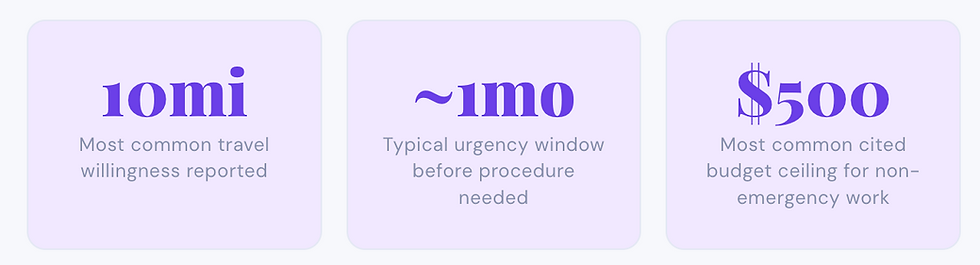
The "within a month" urgency timeline is critical context. Most of these aren't emergencies that need a same-day decision. There's a window sometimes a few weeks where a pet parent could realistically shop around, get a second opinion, or negotiate. They just don't know how, or where to look. That's the exact moment FareVet should show up.
Finding 05
The emotional weight behind every submission
Numbers tell part of the story. The messages tell the rest.
We read submissions from people whose dogs had been hit by cars. From people whose cats were dying and who were up at night checking to see if they were still breathing. From people who had already spent everything they had and were trying to figure out what came next. From retirees on fixed incomes with rescue pets they'd had for a decade.

We share this not to be heavy-handed, but because it matters. Every data point in our database is a real animal and a real person on the other end. The stakes of getting vet pricing right of making it knowable, comparable, and fair aren't abstract. They're personal.

What We're Building
A system that works for everyone
Everything we learned this year has shaped what FareVet is becoming. Our database now covers tens of thousands of priced service records across thousands of clinics in dozens of states. We're building tools that let pet parents search real prices by city and procedure not estimates, not ranges pulled from thin air, but actual clinic data.
We're also building tools for shelters, so that new adopters walk out with realistic cost expectations not just a leash and a hope. And we're building intelligence tools for insurance companies, so that when a claim comes in for $12,669 in Greenville, SC, someone in that process can actually check whether that number makes sense.
The vet industry has operated without price transparency for a long time. That's changing. And if the past year of submissions has shown us anything, it's that pet parents don't just want this information they need it.


Comments